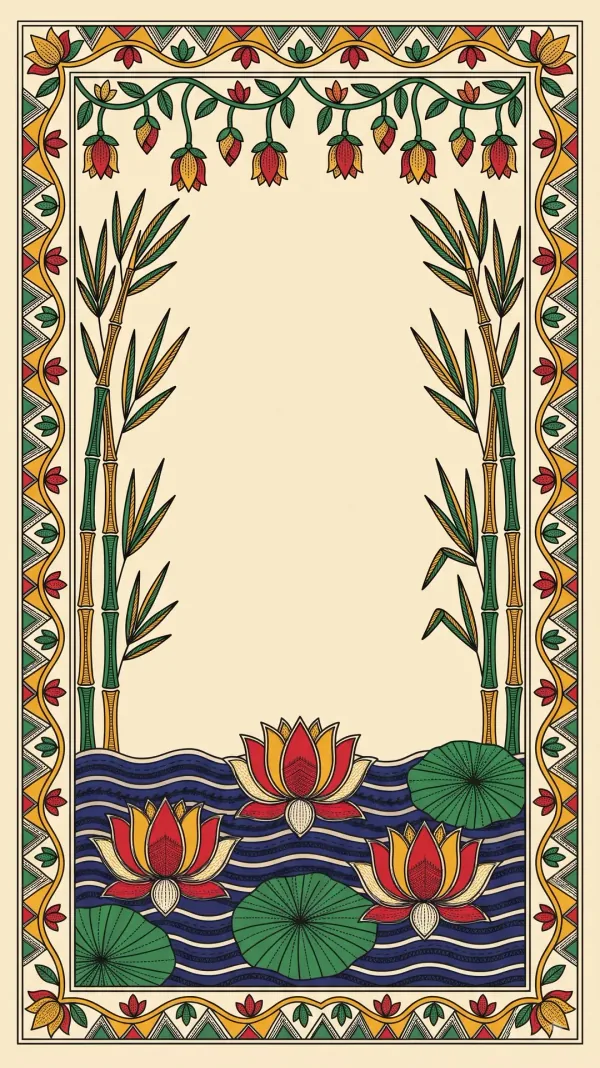
Madhubani wedding invitation: Mithila art for your wedding
A Madhubani wedding invitation carries the oldest wedding art of Mithila: lotuses, fish and bamboo painted in bold double outlines and bright filled colour. For Bihari and Maithili families it feels like home; for everyone else it is simply one of the most beautiful folk styles in India. Here is the story behind the art, what each symbol means, a few notes on Maithili weddings, and our Madhubani design, Janaki Vivah, which you can try with your names for free.
By the Gulabi Card team · Published 6 October 2026
Where Madhubani art comes from
Madhubani painting, also called Mithila painting, comes from the Mithila region: the districts of north Bihar around Madhubani and Darbhanga, and the Terai of Nepal around Janakpur. For generations it was not made for sale at all. Women painted it on the freshly plastered mud walls and floors of their homes, for festivals and above all for weddings, with colours made from turmeric, lamp soot, flowers and leaves, and brushes of twigs and cotton.
The most important wall in a Mithila wedding house was the kohbar ghar, the room where the newly married couple spends its first days. The women of the family covered it with a dense painting of lotuses, bamboo, fish, birds and gods, all wishing the couple love, children and a long life together. That painting is called the kohbar, and almost every Madhubani wedding design today, ours included, borrows from it.
The art reached the wider world in the twentieth century. After the 1934 earthquake in Bihar, a British officer, W. G. Archer, saw the paintings on broken walls and photographed them. Decades later, during a drought in the 1960s, women were encouraged to paint on paper so the work could be sold, and artists such as Sita Devi, Ganga Devi and Mahasundari Devi became known across India. Madhubani painting is now protected by a Geographical Indication (GI) tag for the region.
You will see a few styles: bharni (filled with solid colour), kachni (fine line work, often in one or two colours), godna (patterns from tattoo traditions) and the kohbar compositions made for weddings. All of them share the double outline, the borders of triangles, waves and leaves, and the rule that no space should be left empty.
What the symbols mean
A Madhubani invitation is not just decoration. Each motif is a blessing, and elders in Mithila will read them that way.
Fish (machh)
Fertility, plenty and good fortune. Along with paan and makhana, fish are among the most auspicious things in Mithila, and they are drawn in pairs on the walls of the kohbar.
Lotus (kamal)
Beauty, purity and the bride. In the kohbar painting the lotus pond, often a ring of lotuses, is drawn as the bride's symbol.
Bamboo (baans)
Growth and the continuing family line, because a bamboo grove keeps sending up new shoots. It stands for the groom's side and a long-lasting family.
Parrots and peacocks
Love and the couple. Parrots are messengers of love in folk songs; peacocks bring rain and joy.
Turtle, sun and moon
Long life and a marriage that lasts as long as the sun and moon, painted in the corners as witnesses.
Bihari and Maithili wedding notes for your invitation
Mithila is Sita's homeland. She was Janaki, the daughter of King Janak, and the wedding songs of the region still call every bride Sita and every groom Ram. Vivah Panchami, the anniversary of their wedding in the month of Margashirsha (Aghan), is a festival in Janakpur. If you want one line that every Maithili elder will recognise, a reference to Sita-Ram is it.
A few functions you may want to list, each with its own page on a wedding website:
Tilak (Tilakotsav): the bride's family visits the groom's home to formally confirm the match, a big function in many Bihari families.
Haldi or ubtan: turmeric and gram-flour paste for the bride and groom, usually at home.
Matkor: the women of the family go out singing to dig the first sacred earth for the wedding rituals.
Vivah: the wedding itself, with kanyadaan and sindoor-daan, the moment the groom fills the bride's parting with sindoor.
Chaturthi and the reception: in Maithili tradition the couple stays at the bride's home for the first days, with the fourth-day chaturthi rituals, before the bidai.
The Mithila paag, the round red or maroon cap worn by the groom and the elders, is a proud symbol of the region, and it makes a lovely small icon on an invitation. Many families also add a line in Maithili, a blessing from a vivah geet, or a verse of Vidyapati. On a website you can add these in Devanagari without worrying about space.
Rituals and their names differ between Maithil Brahmin, Kayastha, Bhumihar, Yadav and other families, and between Mithila and Bhojpuri-speaking areas. Treat this list as a starting point and follow your own family's order.
Our Madhubani wedding invitation design
Janaki Vivah is a full wedding invitation website for ₹2,000, drawn in the Madhubani style. It is a digital illustration, not a scanned hand painting, and we say so plainly.
The cover is a kohbar-style frame: red and yellow lotuses on a blue wavy pond, tall green bamboo on both sides and a hanging flower vine above, inside a border of triangles. The inner page is a white village house with fish painted beside its windows, banana trees, clay pots and the same lotus pond.
Every function gets its own page with a Google Maps button, so tilak, matkor, haldi, the wedding and the reception stay clear. Add your parents' voice note, your song, a photo gallery and RSVP.